Harmonious Dissonance
Michael Paglia
In his work on paper and canvas, Denver-based artist Bruce Price has long explored what could be called a post-minimal sensibility, establishing self-imposed rules only to violate them in his process. These violations—creating strictures that are then accidentally or pointedly ignored—reflect the artist’s belief that his thought-processes function in what could be called a non-standard way, what he dubs as his unique neuro-divergence. Price bristles at the idea of labeling this condition as being “on the ADD/ADHD spectrum” since that implies a disability while he sees his neuro-divergence as being an advantage both intellectually and creatively. In addition to this particular precondition to his art making, another basic character feature that also informs his art is his same-sex affectional identity, which he has alternately labeled as gay or queer.
Early exposure to music and science
Born in Topeka, Kansas in 1958, Price’s parents were Robert Whitcraft Price and Noreen Brandt Price. His father was an accomplished pianist whose graduate studies in music were interrupted by his service in World War II, wherein he was conscripted into the Army Medical Corps as a conscientious objector. This experience changed the trajectory of his life because after the war he abandoned his former study of music and pursued instead a medical education, eventually becoming a psychiatrist. Price’s mother shared his father’s passion for music, being a skillful violinist, and his pursuit of science since she was also a microbiologist. Both his parents having a serious interest in music while pursuing scientific careers would wind up having a major impact on the course of Price’s everyday life as well as on his future creative work.
In 1966 Price’s mother died and the family moved to Goshen, Indiana. His father had completed his medical residency in Topeka, establishing his psychiatric practice in the family’s new hometown. A year later, he remarried, giving his
children a loving stepmother, Nancy Rennick Price with whom Price still has a close relationship.
When he was in the 5th grade, Price became seriously interested in music, remarking that, “it was the beginning of years of emersion in classical music.” He had twelve years of piano lessons, and played the Viola. “In orchestra class, there were many students playing the violin,” Price recalled, “and my music teacher pointed that I was fairly large for my age, and could thus handle the viola, so he suggested that I switch instruments, and I did. I became really good with the viola, playing in youth orchestras, and in 10th grade, I became the youngest player ever to become part of the Elkhart Symphony.”
In 1973 and 1974, during his junior and senior years of high school, he was accepted into the National Music Camp, a summer program for gifted young musicians in Interlochen, Michigan. This experience, along with his talent and skill in playing the viola, Price auditioned and was accepted into the Interlochen Arts Academy where he attended from 1974 to 1976. A boarding school with small classes, the academy was a welcome respite from thepublic school he attended back in Goshen. “It was an escape from the bullying”, Price mused, explaining that his being picked on was associated both with his size, and with his not yet self-acknowledged gay identity. It was during his time at the academy that he first came to the conclusion that he wasn’t intellectually challenged, a serious concern that he’d had for many years. It was also while studying at Interlochen that he was first exposed to the visual arts, having been, heretofore, obsessed with classical music.
Price spent the following two years in Indiana playing for the Evansville Philharmonic while attending the University of Evansville. In a music theory class, Price could not process “ear training,” leading him to drop out of school and to seek out a therapist. He moved to Mishawaka and played with the South Bend Symphony while his day job was working as a hospital orderly
in an emergency room. Price took to the high-pressure situation, explaining, “you never knew what was going to happen, so it satisfied my need for novelty.” In therapy, his councilor facilitated his coming out as a gay man in 1981.
Finding his New Vocation and Embracing his Newly Realized Identity
Price acted on his new identity by escaping his home state and relocating to Minneapolis, Minnesota that same year. He worked at a nursing home and as a waiter. He had stopped playing the viola and though he had been steeped in classical music for his entire life, he suddenly embraced disco, punk and new wave which he was hearing in the gay bars and clubs. For Price, and for a raft of cultural theorists, the high/low collapse of going from classical to disco in one fell swoop, is quintessentially gay.
It should be noted that the 1980s into the early 1990s was a perilous time to be a single gay man. That era marked the high point of the AIDS crisis which particularly effected that community, killing many in Price’s generation. In fact, the acronym AIDS had been coined in 1981, the same year Price had come out. Price would ultimately find himself caring for AIDS patients in his work in hospice care.
At the same time he was initially embracing his gay identity, he was embark-ing on a self-education course in art, frequently visiting the Walker Art Center, with its national class collections of modern and contemporary art. “I became very moved when I was introduced to Abstract Expressionism”, Price remembers, as well as Minimalism, in some sense polar opposites of one another with the former grounded in the painterly gesture, with the latter, the elimination of the evidence of the mark-making process. There was a small retrospective of the work of Sol LeWitt at the Walker, and
Price had a strong attraction to that and to the work of Donald Judd. “I was fascinated by the way Minimalism transgressed our expectations of what art is about,” Price notes, “I called it ‘the transgressive sublime.’” Price wasn’t just looking at art, he was thinking about it, and writing down those thoughts, developing ideas about the basic nature of art, and imagining a career in the visual arts. These ideas and others now fill nearly twenty bound journals.
These entwined interests led inevitably to Price making art, initially creating a series of drawings which he regarded as a minimalist undertaking that involved a logical progression (plate 2). Using gridded graph paper and felttipped pens, Price laid out a grid of marks that he called dots that filled the entire page. The drawings alternated colors. “In one, there would be a red dot, and then a blue dot, in another, a line of red, and a line of blue, and next, two lines of red, two lines of blue, heading toward one that was all red, and another that was all blue,” Price explains. “While doing the series, I made a mistake. I thought, ‘do I throw this out or accept it?’ I decided that disposing of the drawing with the mistake, indicated a design restraint in the process. So instead of putting the ‘spoiled’ drawing aside, I adapted to the error.This led to my first art rule: ‘abandon anything at any time for any reason.’
I was learning about Minimalism by violating its principles. This fed into my neuro-divergence, I was trying to prove that this kind of adaptation to errors had an evolutionary purpose and was not a short-coming.” Though these drawings were essentially his initial efforts, they reveal a maturity of vision that elegantly expresses his future trajectory in his art practice.
Price left Minneapolis in 1989 and first moved briefly to Michigan to take care of his cousin who was afflicted by AIDS, but sadly he died within a week of Price arriving. Price then returned briefly to Indiana before relocating to Dallas, Texas. He was joining his sister Lynn Price, a physician. From 1992 to 1994, Price attended Richland College in Dallas where he embarked on his first formal training in art, but “I got bogged down in the assignments, and didn’t make much of my own work.”
Kismet Connections Lubricate His Ascent in the Denver Art World
Lynn, who worked for Kaiser Permanente, decided to move to Denver and Price moved with her. He was considering continuing his art education at what was then called Metropolitan State College of Denver, when by chance, on a visit to the Peyton-Rule Gallery, he met co-owner Cydney Peyton who recommended that he instead attend the Rocky Mountain College of Art and Design. This was so Price could study with Clark Richert, Price’s future mentor, whose work was hanging in the gallery. Given Price’s already developed aesthetic sensibility, it was as though his previous work had anticipated if not prepared him for his fateful, years-long professional relationship with Richert.
Price would not only earn a BFA in 1997 at RMCAD, but he became the first student to have his graduation exhibit, Between Rigor and Indulgence, presented in a commercial gallery, Rule Modern & Contemporary, the successor venue to Peyton-Rule where his Denver sojourn began. After graduation, Price continued to work with Richert for many more years, as a fellow faculty member at RMCAD. Richert created a job for Price at the college, launching the Institute for Experimental Studies especially for him, and naming his former student as its founding director.
For Richert, Price was a revelation, believing that the younger artist would have been perfect for the legendary Colorado art collective, Criss-Cross, had he only been 15 years older. Criss-Cross, established in Boulder, included many pattern painters, like Richert, a cutting-edge group whose work would become known nationally. But even without that credential, Price would find himself a late arrival in the context of this important current in the contemporary art history of Colorado—hard-edged abstraction. His association with Richert would link him to the others in Criss-Cross, such as Charles DiJulio, Richard Kallweit and, notably, George Woodman. When Richert had embarked on graduate work at the University of Colorado in the 1960s, one of his teachers was Woodman who was at that time creating paintings of non-repeating patterns. The example of these pattern paintings sparked Richter to completely revise his stylistic vocabulary. Thus, Price forged a new link in the multigenerational chain of artists with an interest in patterns that connected him to Richert, and via this connection, all the way back to Woodman. (These pattern painters can also be associated with other Colorado artists who embraced hard-edged abstraction, such as Ludwig Sander and Charles Bunnell in the 1950s, plus David Yust and Beverly Rosen in the 1960s and 1970s).
In addition to teaching at RMCAD, Price also taught briefly at the Community College of Denver, and then, in 2004, he kept his job at RMCAD, left CCD,
and enrolled in the Maine College of Art’s non-residential MFA program, receiving his degree in 2006. From the early 2000s to the present, Price’s efforts have been showcased in many solo exhibits, including those at Rule Gallery, Ron Judish Fine Art, OK Harris, the Denver Art Museum, the Denver, Museum of Contemporary Art, the Boulder Museum of Contemporary Art, among many other venues.
The earliest of the mature works featured in this exhibition date to 1997 and 1998. It was during this time that Price was concerned with hard-edged color field abstractions, some with patterns (plates 4–9). The colors he employed are rich and often being comprised of a mixed set of complex tones, with their striking juxtaposition to one another being used to amplify the visual punch of the pieces. And the application of the pigments often unexpectedly reveals the mark of the brush. The strongest of them have a decidedly decorative character, which Price calls ornamentation, a quality that he views as being a function of the basic social role of visual art. Works from the early twenty-first century reveal tight patterns covering square panels set on the diagonal, a clear return to the approach of his earliest drawings (plates 17–20).
Around 2005, his compositions explode into a mannered triumph in which Price abandons flatness and unity (plates 21 and 22). Patterns are set in perspective receding into the background, with patterns and fields violently colliding. They are positively baroque having so thoroughly violated their minimalist roots. These pieces are maximalist. Some even eschew employing hard-edges and geometry.
A huge serendipitous break-through in his technique came in 2011, when Price was near the end of his three-year stint as a resource artist at the RedLine Contemporary Art Center. His sister, Lynn, with whom he has lived for decades, is an expert seamstress. When creating a new wardrobe for another of Price’s sisters, Gaile, Price retrieved an old gingham dress that Gaile was donating
to charity. The pattern, in red and white, was functioning in much the same way that his painted patterns were, so Price drafted the fabric into being a substitute not only for a painted passage, but also to serve as a ready-made compositional device. There’s a certain conceptual brilliance in the gingham appropriations that perfectly riffs off his drawn and painted patterns.
Because Price addresses his painterly practice as being more about process than being object-oriented, and because of the way he is able to interpret and reinterpret his already established exercises, he has been able to continuously readdress each of the different approaches he has already developed over the years. He continues to expound along the same lines he has earlier formulated, as well as constantly and continuously redeveloping his guiding concepts to create new types of work.
All along, Price has also created a raft of three-dimensional objects, essentially multi-sided paintings or, in some cases, drawings, as opposed to being full-fledged sculptures. He has also dabbled in product design using his patterns to accent functional articles like hats, mugs and backpacks that he has sold through his virtual shop, “Giddy Galore” on Shopify. These
commodities are aesthetically direct extensions of his painting and drawing. Standing outside his artful traditions, surprisingly, are his ceramics, which he’s worked on for years. These pieces, unlike the main current of his art,
are expressive, relying on emphatic finger marks in the clay for their visual presence. In terms of their creation, they have an improvisational character which is plainly at odds with the thoroughly systemic pictorial language employed in his drawings, paintings, and even his functional products.
The Marks of Price’s Neuro-Divergence and his Gay Identity in his Work
Price’s self-acknowledged neuro-divergence and his gayness have together represented a kind of freedom for his art. Both are well-expressed in the specific ways his work contradicts that of his mentor, Richert, and defies the straightforward “rules” of classic Minimalism and Pattern Painting.
Despite the superficial affinities that conjoin their efforts, their respective conceptual underpinnings, as well as their final results, are distinctly different from one another. Conceptually, Richert is illustrating mathematical equations while Price’s compositions are instinctual, illustrating his ideas about art and about himself. Richert uses color to represent elements of his calculations, while Price uses color instead as simply ornamental, a function of his interest in expressing pleasure and conviviality. The finished paintings differ as well in that Richert’s have a tight formal organization whereas Price’s paintings are loose, often dispensing with the rhythm he himself had already established in a particular piece. One of the most striking distinctions between Richert’s compositions and Price’s is the incorporation of ready-made patterns in the form of the gingham prints, something that would be beyond the pale for Richert. All of these differences simultaneously reference Price’s LGBTQ identity, and his non-standard perceptions of reality.
Conclusions
The trajectory of Price’s stylistic development has had an astoundingly direct through-line. Before he was a visual artist, he was already interested in a process of creating art via repeated actions and forms. This is clear even in his earliest work, the dot drawings made in Minneapolis, which were clearly the heir to his time as a violist. In both he was carrying out a rhythmic action in order to create art, in the case of the drawings, holding the marker and moving it repeatedly up and down onto the paper in a similar movement to the stroking of the strings with the bow that had produced music from his viola.
Though only a nascent artist when he first came to Denver, he was nonetheless already on a decided aesthetic path he had forged since the very beginnings of his work as a visual artist. This established vision made his serendipitous connection with Richert, first as mentor, and later as colleague, a truly charmed encounter of two artists on compatible tracks conceptually and visually. Furthermore, Richert’s pedagogical method, characterized by an embrace of freedom of expression, fit Price’s love of independence perfectly. As a result, Price’s work would become both something of an homage, and an incisive critique of Richert’s methods and results. In this way, Bruce Price would open up and then fill a distinct niche at the top ranks of Denver’s contemporary art scene.
Michael Paglia has worked as an art critic, a curator, an educator and a script writer. His principal focus has been the art and architecture of Colorado and the American West. His columns appeared in Westword, a Denver weekly, from 1995 to 2020. His reviews have also been published in Art News, Architecture, Modernism, Art & Auction, Sculpture and Art Ltd. In addition, Paglia has been an author or co-author of more than a dozen monographs and books, notably Colorado Abstract and Texas Abstract.
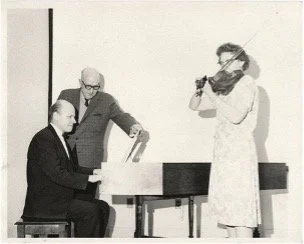
Dr. Robert W. Price, MD (piano)
Dr. Noreen Price, PhD. (violin), 1957
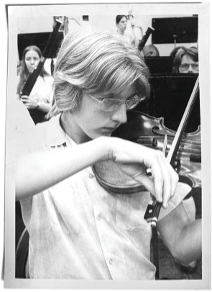
Bruce Price, 1975
World Youth Symphony
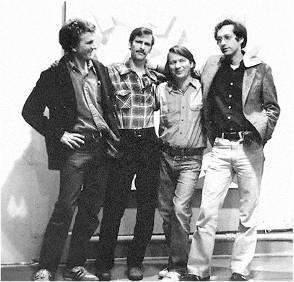
Criss-Cross members (L–R):
Fred Worden, Charles DiJulio,
Clark Richert and Richard Kallweit
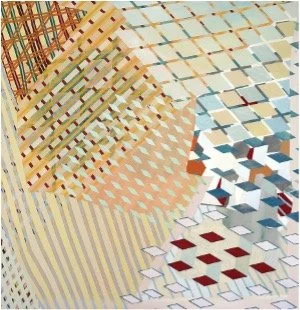
Bruce Price, Slice, 2005
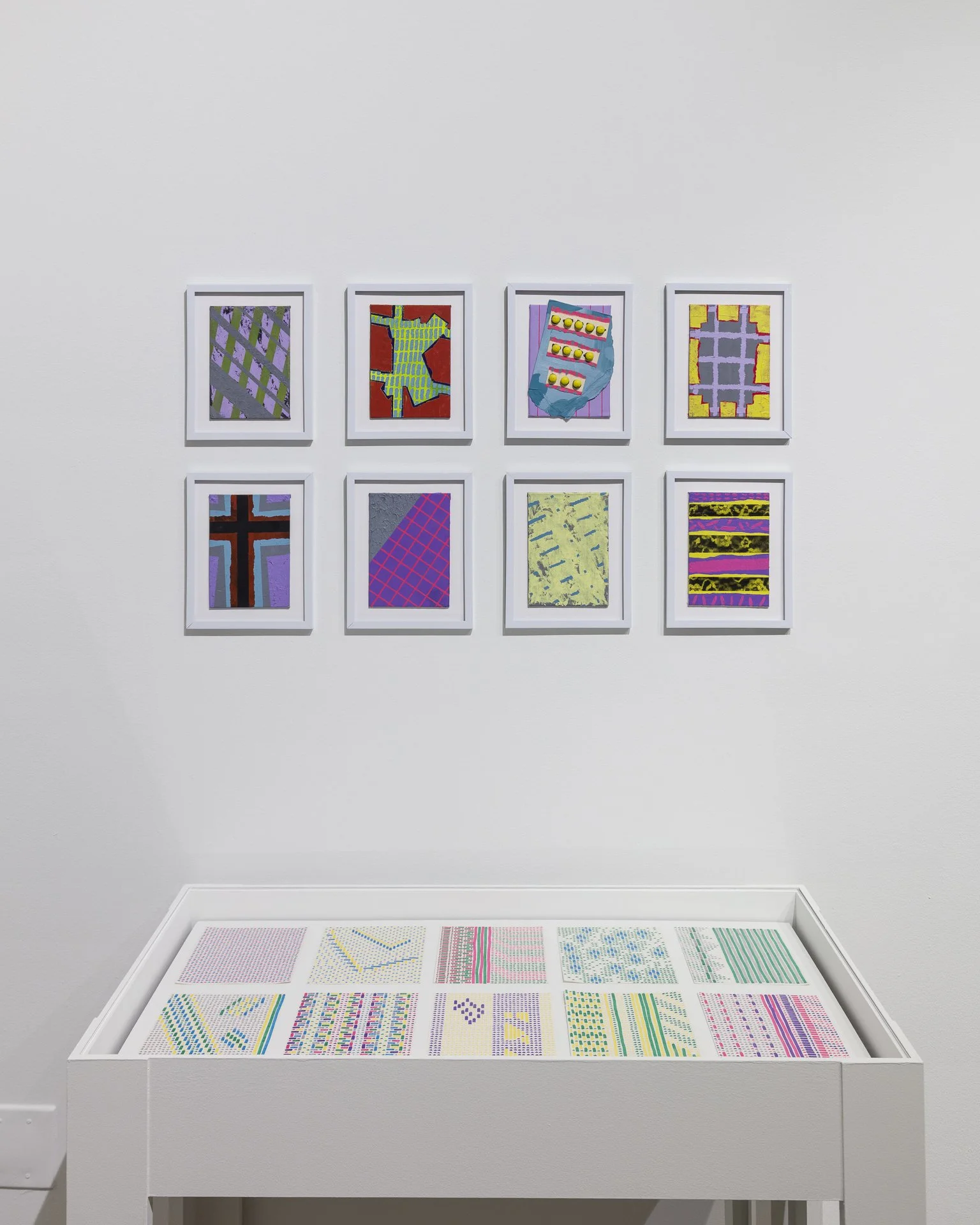
Works from 1986, Minneapolis